VERTIX & GLTH
Vertix and GLTh are cost-efficient engineered laminated timber products as a part of our Glulam 2.0 initiative; designed for applications, including lintels, rafters, ridge beams, and floor beams. Products are available in H1.2 or H3.2 treatment, are independently tested for structural and fire performance, and deliver strong sustainability and cost advantages over traditional building materials.

Do you have a project you’d like to discuss?
We’d love to talk with you about it.
Choosing The Right Laminated Timber Solution
Red Stag TimberLab offers three engineered timber solutions, each designed for specific applications. Selecting the right product depends on span, member depth, treatment requirements, and project complexity.
Traditional Glulam
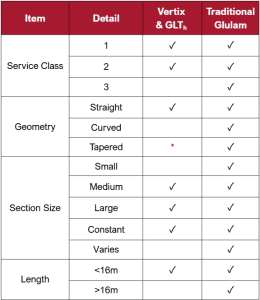
Traditional glulam is the preferred solution for long-span, curved, or MCA-treated structural members where maximum design flexibility and performance are required. It is ideally suited to beams exceeding 16.5m in length, curved elements, and applications requiring MCA treatment.
Vertix
Vertix is designed for deep structural members, providing an efficient and economical alternative to traditional glulam for straight beams over 420mm deep and up to 16.5m long. Its vertically laminated configuration delivers enhanced stiffness and structural efficiency for demanding load-bearing applications.
GLTh
GLTh is a cost-effective laminated timber solution for straight structural members up to 420mm deep, making it ideal for lintels, rafters, ridge beams, and floor beams in residential, commercial, and industrial projects.
When to Use Traditional Glulam vs Vertix and GLTh
Why Multiple Solutions?
GLTh and Vertix have been developed to provide more cost-effective alternatives for standard structural applications, while traditional glulam remains the optimal choice for longer spans, complex geometries, and specialised treatment requirements. This ensures projects receive the most efficient and economical timber solution for their specific performance requirements.

SEE DESIGN GUIDE