
Project Description

West Gate Tunnel – Eel Nets
Project Description
CREDITS: Architect: Wood Marsh Architecture / Structural Engineer: Create Ltd / Main Contractor: CPBJH JV (CPB Contractors + John Holland) / Products: Glulam
The Project
Melbourne, VIctoria, Australia
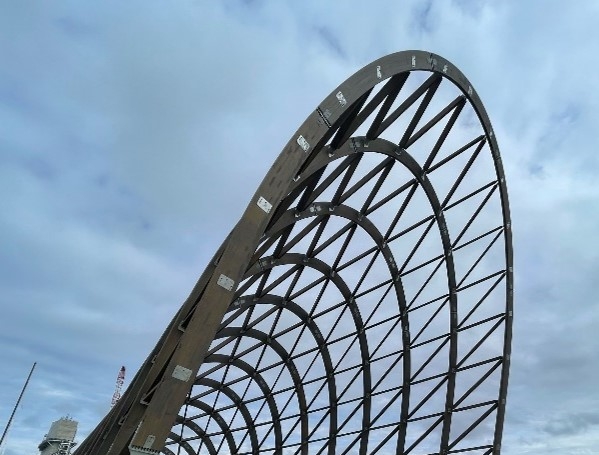
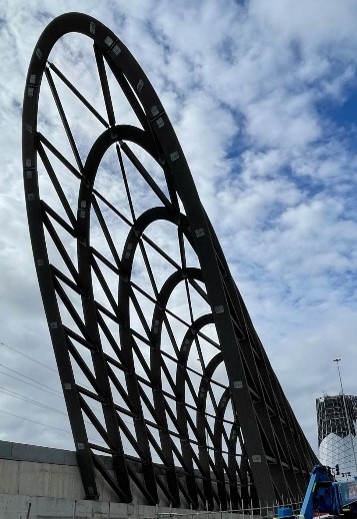
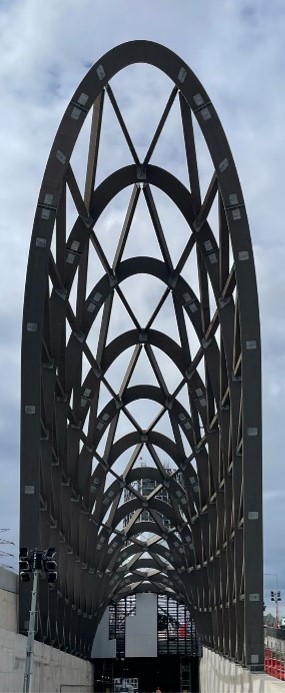
As part of the transformative West Gate Tunnel Project in Melbourne, the Eel Nets portal structures are architectural markers that signify key entry and exit points of the new road tunnels. These large-scale glulam constructions act as both sculptural landmarks and transitional light filters, easing driver adjustment to sudden changes in brightness as they move in and out of tunnel environments.
Red Stag TimberLab (RSTL) was responsible for the structural design, manufacture, and international logistics of all three distinct Eel Net structures: North Portal, South Outbound, and South Inbound. Each structure varied in geometry and span, tailored to its specific tunnel interface and site condition. The North Portal, the largest of the three, stretches 121 metres in length and rises up to 39 metres high to accommodate dual-direction traffic.
Structural Design
The Eel Net structures consist of large inclined elliptical glulam arches spanning the roadway, providing the primary lateral and vertical support. These were in turn supported by a triangulated arrangement of glulam struts that tie the timber structure back to the tunnel structure. Infill struts provide longitudinal stability and additional in plane shear stability through the whole structure through diaphragm action.
The arches are designed as fully continuous, with large moment splice connections used to allow for multiple parts to be connected together to form each arch (due to finished size/shape being too large for manufacturing or transport as a single element), the struts are treated as having a pinned connection at each end where meets the arches.
Arches are connected through pinned connections to the concrete supporting structure.
RSTL contracted Create Ltd to provide full structural design services, Create had been working with us throughout the many concepts and design schemes considered over several years during tendering and preconstruction phases.
RSTL & Create worked with the local design team in Australia to understand all the project requirements, complete all analysis and calculations not only for the Eel Net but all interfacing and supporting structures in a parallel manner as designs progressed.
Understanding the wind-dominant nature of the structures, RSTL and Create Ltd collaborated with MEL Consultants to conduct wind tunnel testing using 3D-printed 1:200 scale models. The findings enabled precise structural calculations for both global and local wind pressures, informing resilient and refined design outcomes.
Prototyping and Fabrication
RSTL developed prototypes to test-fit key connections and refine CNC detailing early in the process, additional factory fit test fitting was completed to ensure fitment of site applied elements.
A significant innovation was the introduction of a new adjustable steel press system for the manufacture of curved glulam elements. Previously taking multiple days per press cycle, the new system enabled daily turnaround, dramatically improving efficiency and throughput.
Each arch segment, some as large as 1400x300mm and 30m long, were pressed over depth and machined at RSTL’s Auckland facility using 5-axis CNC technology to maintain mm precision of shape across the element.
Radiata Pine was used throughout, H3.2 treated and bonded with resorcinol glue, finished with CD-50 preservative systems for added durability.
Over 830 timber elements and 500 tonnes of steel brackets and fixings were manufactured and test-fitted off-site before dispatch. Factory assembly included full bracket installation and detailed QC processes, ensuring seamless site assembly and minimised on-site risk.
Logistics and Construction
Given the scale and shape of the components, logistics required a hybrid of shipping solutions: flat rack containers, standard containers, and part-charter shipping for oversized elements. A dedicated off-site facility was used in Melbourne for laydown, final pre-assembly, and site delivery staging.
Installation proceeded arch-by-arch, starting from the rear of each portal. After each arch was installed, infill struts and survey checks followed before moving on to the next. This staged approach enabled precision assembly alongside active roadways and live work zones.
Digital Craftsmanship and Cultural Expression
The Eel Nets stand as a powerful example of what’s possible when digital fabrication meets cultural architecture. Red Stag TimberLab’s end-to-end delivery from design collaboration through to fabrication, testing, and international logistics, demonstrates the scalability of engineered timber in large-scale infrastructure while honouring local heritage in built form.