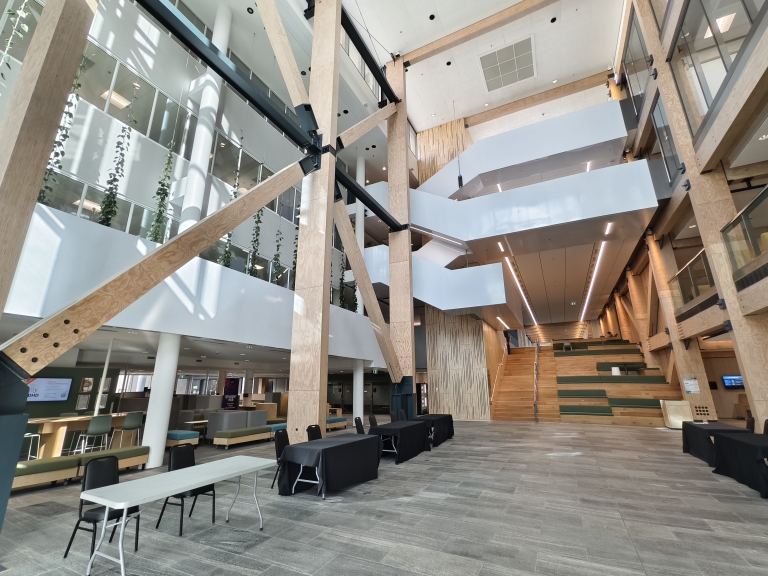
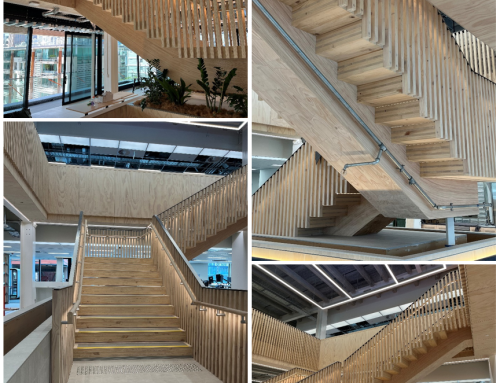
AUT sought to create a new flagship building – Tukutuku, at its North Campus in Auckland. The goal was to deliver a sustainable, culturally integrated, and future-focused learning environment that would serve as the social and academic heart of the campus. The project needed to meet ambitious embodied carbon targets, integrate Māori cultural narratives, and provide a high-performance, low-energy facility for over 2,000 students and staff across a 9000m2 floor footprint.
Red Stag TimberLab's Involvement
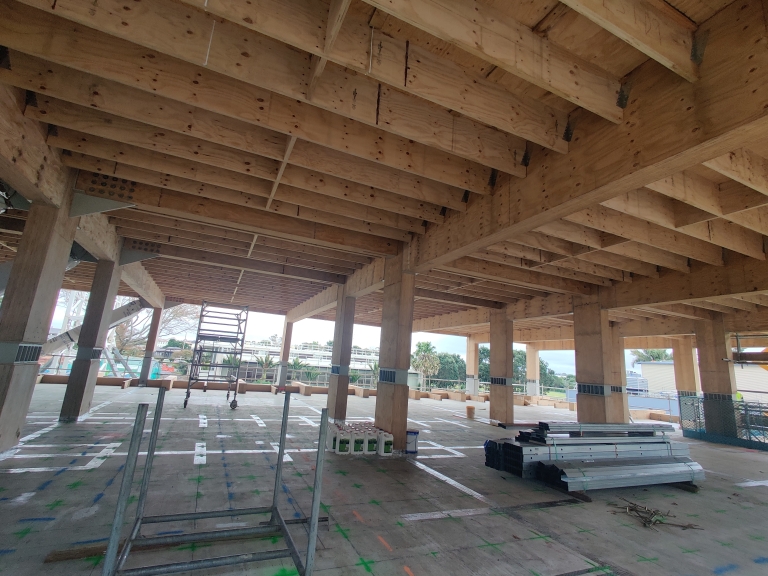
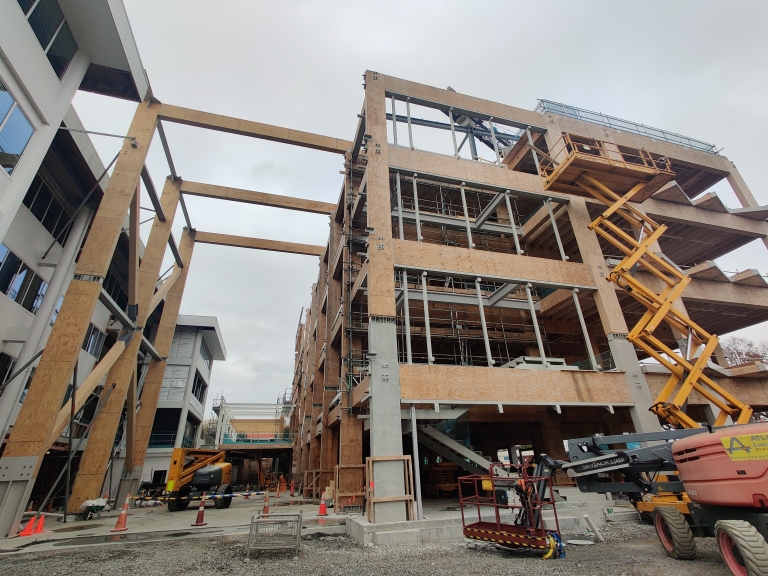
Red Stag TimberLab (RSTL) supplied the LVL mass timber frames for the Tukutuku project. This required precision engineered, large-scale timber components to support the four-storey structure which had high seismic and fire requirements. RSTL supplied the LVL beams and columns for the post-tension portal frames, which formed the backbone of the building’s structural system. These components were critical in achieving the building’s lightweight, low-carbon design, and enabled rapid, accurate on-site assembly.
Digital Fabrication
Red Stag TimberLab leveraged advanced digital fabrication techniques to deliver the complex post-tension timber elements. Using 3D modelling and CNC machining, the team ensured millimetre accuracy in the production of the LVL frames, which weighed up to 31 tonnes. This digital workflow minimised waste, reduced on-site construction time, and ensured seamless integration with other prefabricated systems such as the Potius floor.
Sustainability and Renewable Energy
By supplying low-carbon, engineered timber, RSTL helped halve the building’s embodied carbon compared with a traditional steel and concrete structure.
As New Zealand’s lowest-carbon mass timber supplier, RSTL integrates renewable energy into its production processes and is a net exporter of electricity into the national grid.
Mass timber is one fifth the weight of concrete which results in the finished building being approximately 50% the weight of a traditional build. The lightweight nature of mass timber significantly reduced the volume of concrete required to support the building on its poor soil conditions. A lightweight solution on poor soils was both an economic and low-carbon design option for Tukutuku.
Total volume of LVL = 494m3
Total weight of LVL = 287 tonnes
Embodied carbon associated with the LVL = 326 tonnes of CO2
Results
Red Stag TimberLab’s contribution was instrumental in helping the Tukutuku building meet its ambitious goals for sustainability, cultural integration, and structural innovation. By supplying precision-engineered, post-tensioned LVL components, RSTL enabled the creation of a lightweight, sustainable structure that significantly reduced carbon emissions. The digital fabrication methods employed by RSTL ensured millimetre accuracy, and minimised waste; aligning perfectly with AUT’s sustainability strategy.
Tukutuku is recognised as one of the most energy-efficient tertiary education buildings in New Zealand and RSTL’s expertise in engineered timber was a key factor in achieving AUT’s vision. We were proud to be a key supply partner for this flagship project.
Project Credits
Client: AUT (Auckland University of Technology)
Architect: Jasmax
Engineer: BECA
Construction: Naylor Love
Product: LVL
Contact the Red Stag TimberLab team to discuss how you can include mass timber in your upcoming project.